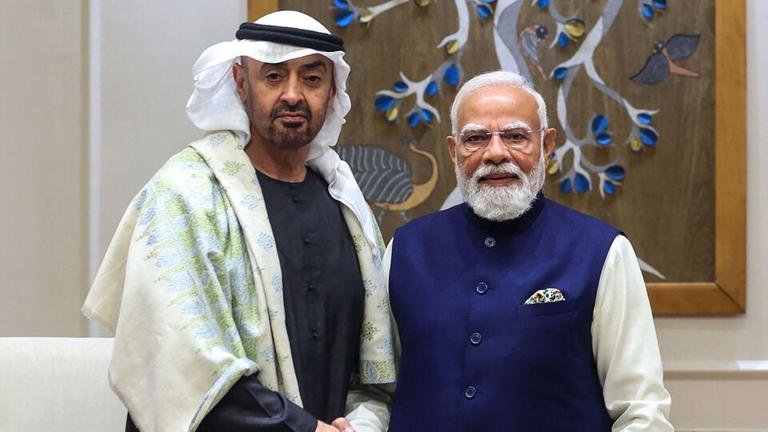
In a remarkable moment underscoring the growing strength of India‑UAE relations, Prime Minister Narendra Modi personally welcomed United Arab Emirates President Sheikh Mohamed bin Zayed Al Nahyan during his short official visit to New Delhi. The warm greeting at the airport and the two leaders travelling together towards the heart of India’s capital spoke volumes about the deep personal rapport that now underpins diplomatic ties. What might have been a routine protocol gesture instead conveyed trust and mutual respect, setting a distinctly positive stage for substantive strategic talks that followed.
Against the backdrop of global challenges and shifting geopolitics, this brief but impactful meeting turned out to be far more than a ceremonial call. It symbolised a shared commitment by both nations to work together on critical global issues – from technological innovation to economic partnerships and security cooperation.
Energy security was one of the headline priorities discussed during the two‑hour meeting. Both leaders highlighted the importance of reliable energy supplies in a volatile global climate. A landmark 10‑year liquefied natural gas (LNG) agreement was welcomed, under which India will receive 0.5 million tonnes of LNG annually from 2028 onwards, positioning the UAE as one of India’s key long‑term energy partners.
But beyond traditional energy resources, nuclear cooperation emerged as a significant area of focus. India and the UAE agreed to explore collaboration in advanced nuclear technologies, including large nuclear reactors and innovative Small Modular Reactors (SMRs). These discussions align with India’s recent reforms in its civil nuclear sector, creating fresh opportunities for international partnerships that can enhance energy reliability and sustainability for decades to come.
By embracing nuclear energy together, both countries signal their readiness to pioneer cleaner and more efficient power solutions. This forward‑looking approach not only strengthens energy ties but also aligns with global climate goals and long‑term economic growth strategies.
Technology – especially artificial intelligence (AI) – stood at the forefront of talks, highlighting a shared belief in innovation as a catalyst for future growth. Both leaders agreed that AI and emerging digital technologies must be central pillars of the India‑UAE partnership. Plans were set in motion to work towards establishing a supercomputing cluster in India, a move aimed at significantly boosting computational capacity for research, industry, and governance.
In addition, the UAE expressed interest in investing in expanded data centre infrastructure in India, helping build a robust digital ecosystem that can support next‑generation technological advancements. Discussions also touched on visionary concepts like “Digital Embassies,” based on mutually recognised digital sovereignty – a potential game‑changer in secure data exchange and cross‑border digital cooperation.
President Sheikh Mohamed also pledged support for India’s upcoming AI Impact Summit, set to be hosted in early 2026. This endorsement signals more than symbolic backing; it reflects a shared ambition to lead global thought leadership in AI governance, ethics, and innovation.
The meeting marked a pivotal moment in defence cooperation between India and the UAE. A Letter of Intent was signed to work towards a Strategic Defence Partnership – a framework that promises to deepen collaboration across defence industries, joint training, and advanced technologies. This partnership builds on recent engagements between military leaders from both nations and expands the scope for future joint initiatives.
Both leaders took a firm stand against terrorism, unequivocally condemning all forms of violent extremism and cross‑border terror. They committed to enhancing cooperation through existing international frameworks to combat terror financing and money laundering, signalling a joint determination to create safer, more secure societies not just regionally, but globally.
By emphasising shared security interests, India and the UAE have positioned themselves as partners not only in economic growth but in safeguarding peace and stability across vulnerable regions.
Economic cooperation was a cornerstone of the discussions, reflecting the rapid growth in bilateral trade since the Comprehensive Economic Partnership Agreement was signed in 2022. With trade already surpassing $100 billion, the two nations set an ambitious target of doubling this figure to $200 billion by 2032. This bold goal reflects not just optimism, but a concrete belief in mutual economic opportunities that span industries and sectors.
The talks also reviewed progress on initiatives aimed at boosting trade and investment. Discussions included the potential participation of UAE investors in India’s special investment region in Dholera, Gujarat – a sprawling project envisioned to host energy facilities, transport infrastructure, ports, airports, and smart urban developments. Such collaborations could accelerate regional growth, create employment, and invite global businesses to participate in one of the world’s fastest‑growing markets.
There was also emphasis on supporting micro, small, and medium enterprises (MSMEs), with frameworks like virtual trade corridors and Bharat Mart being positioned as bridges to connect Indian businesses with West Asian, African, and Eurasian markets.
The meeting went beyond strategy and economics to embrace cultural and scientific harmony. Both countries agreed to strengthen cooperation in the space sector, unlocking potential for collaborative missions, satellite technologies and commercial space exploration initiatives that can fuel innovation and inspire new generations of scientists and entrepreneurs.
Food security and agricultural linkages were also part of the conversation. Indian stakeholders and UAE partners explored ways to enhance supply‑chain resilience and technical collaboration that can benefit farmers and consumers alike.
Significantly, both leaders acknowledged the deep people‑to‑people links that bind the two nations, particularly with millions of Indians contributing to the UAE’s vibrant society. Plans to promote youth exchanges and cultural initiatives, such as establishing a “House of India” in Abu Dhabi, underscored a commitment to nurturing shared heritage and mutual understanding.
Towards the end of their engagement, the two leaders also exchanged views on regional and international issues. They reiterated support for peace and stability in West Asia and globally. The UAE conveyed strong backing for India’s leadership role as chair of the BRICS forum in 2026, while India reciprocated support for important UAE‑hosted global events.
This alignment on global platforms reflects how the India‑UAE partnership is not limited to bilateral goals, but extends to shaping collaborative responses to global challenges, from economic resilience to peacebuilding.
What began as a brief two‑hour visit quickly became a milestone in India‑UAE relations – marked by warmth, strategic depth, and a bold vision for the future. Prime Minister Modi and President Sheikh Mohamed bin Zayed Al Nahyan showcased the true spirit of partnership: blending trust with action, innovation with purpose, and shared ambition with concrete deliverables.
As both nations pursue energy resilience, digital leadership, defence cooperation, and people‑centric ties, their partnership stands as a shining example of how nations can collaborate to shape a peaceful, prosperous, and forward‑looking global landscape.
Do Follow Estate Magazine on Instagram
Read More:- Dubai Square: Emaar Launches World’s First Spectacular Drive-Through Mall 2025